Saturday, October 29, 2011

The 7 Habits of Highly Effective People

It is just a sneak overview of the book "The 7 Habits of Highly Effective People", by Stephen Covey. This book is essential to help us to be more effective and productive!

Private Victory:

1. Be Proactive - Principles of Personal Vision
2. Begin with the End in Mind
3. Put First Thing First - Principles of Personal Management

Public Victory:

4. Think Win-Win - Principles of Interpersonal Leadership
5. Seek First to Understand, Then to be Understood - Principles of Emphatic Communication
6. Synergize - Principles of Creative Cooperation

Renewal:

7. Sharpen the Saw - Principles of Balanced Self-Renewal

For a detailed explanation of the habits, please kindly read the book! This post also serves to remind myself of those seven habits that I should practice daily, especially Habit #5!

Wednesday, October 12, 2011

The 13 Principles to Riches

What do you want the most?

Is it money?
Is it fame?
Is it power?
Is it contentment?
Is it personality?
Is it a piece of mind?
Is it happiness?

The thirteen steps to riches described by Napoleon Hill offer the shortest dependable philosophy of individual achievement ever presented for the benefit of the man or woman who is searching for a definite goal in life. Napoleon Hill is the Father of Success Philosophy. After a few years studying the traits of successful men, I finally understand and experience that every GREAT success originates from a BURNING desire. It is the starting point of all achievement, the first step toward riches. Below are the 13 critical steps and elements mentioned by Napoleon Hill, that have inspired millions of successful men in these two centuries! See how many criteria do you fulfill.


  1. Desire - the starting point of all achievement
  2. Faith - visualization of, and belief in attainment of desire
  3. Auto Suggestion - the medium of influencing the subconscious mind
  4. Specialized Knowledge - personal experiences or observations
  5. Imagination - the workshop of the mind
  6. Organized Planning - the crystallization of desire into action
  7. Decision - the mastery of procrastination
  8. Persistence - the sustained effort necessary to induce faith
  9. Power of the Master Mind - the driving force
  10. The Mystery of Sex Transmutation - the tenth step toward riches
  11. The Subconscious Mind - the connecting link
  12. The Brain - a broadcasting and receiving station for thought
  13. The Sixth Sense - the door to the temple of wisdom
Last but not least, we must outwit the six ghosts of fear to achieve the success we desire. As a matter of fact, success requires no apologies; failure permits no alibis!

The Six Ghost of Fear

According to Napoleon Hill, there are six basic fears, with some combination of which every human suffers at one tie or another. Most people are fortunate if they do not suffer from the entire six. Named in the order of their most common appearance, they are:


  1. The Fear of POVERTY
  2. The Fear of CRITICISM
  3. The Fear of ILL HEALTH
  4. The Fear of LOSS OF LOVE OF SOMEONE
  5. The Fear of OLD AGE
  6. The Fear of DEATH
All other fears are of minor importance, they can be grouped under these six headings.

Fears are nothing more than just states of mind.

Tuesday, September 27, 2011

30 Major Causes of Failure

1. Unfavorable Hereditary Background
2. Lack of Well-Defined Purpose in Life
3. Lack of Ambition to Aim above Mediocrity
4. Insufficient Education
5. Lack of Self-Discipline
6. Ill Health
7. Unfavorable Environmental Influences During Childhood
8. Procrastination
9. Lack of Persistence
10. Negative Personality
11. Lack of Controlled Sexual Urge
12. Uncontrolled Desire for "Something For Nothing"
13. Lack of Well-Defined Power of Decision
14. One or More of the Six Basic Fears
15. Wrong Selection of a Mate in Marriage
16. Over-Caution
17. Wrong Selection of Associates in Business
18. Superstition and Prejudice
19. Wrong Selection of a Vocation
20. Lack of Concentration of Effort
21. The Habit of Indiscriminate Spending
22. Lack of Enthusiasm
23. Intolerance
24. Intemperance
25. Inability to Cooperate with Others
26. Possession of Power which was not Acquired through Self Effort
27. Intentional Dishonesty
28. Egotism and Vanity
29. Guessing instead of Thinking
30. Lack of Capital

By: Napoleon Hill

Thursday, August 4, 2011

Reactive vs Proactive

I always say, "I am fully responsible for my life. That's what I choose. That's what I want to do." The matter of the fact is I choose to be proactive. Just so lately I have always listened to people saying that, "I have to do this. I have to do that. I have no choice. I have to be this. I have to be that. etc." So today I am writing a post about "reactive vs proactive" as a sharing.

Proactive people choose to act. Reactive people choose to be acted upon. Reactive people say I have to do it. Circumstances or other people are forcing me to do what I do. I'm not free to choose my own actions. They let life controls them. On the other hand, proactive people know that they are in charge of their life.

The language of reactive people absolves them of responsibility.

Because our attitudes and behaviors flow out of our paradigms, if we use our self-awareness to examine them, we can often see in them the nature of our underlying maps. Our language, for example, is a very real indicator of the degree to which we see ourselves as proactive people.

Reactive Language: There's nothing I can do. That's just the way I am. He makes me so mad.
They won't allow that. I have to do that. I can't. I must. If only.

Proactive Language: Let's look at our alternatives. I can choose a different approach. I control my own feelings. I can create an effective presentation. I will choose an appropriate response. I choose. I prefer. I will.

That language comes from a basic paradigm of determinism. And the whole spirit of it is the transfer of responsibility. I am not responsible, not able to choose my response.

Any NLP practitioners will tell you that your words will be your reality. So listen to your language. Examine what type of person you are because every change starts from awareness. Ask yourself, "Am I always in direct control of my problem? Am I always in charge of my life?" Then decide or not to make a paradigm shift.

At any rate, you can choose to be proactive by first changing your language.

Choose your words wisely. Because..
Your Words = Your Reality.

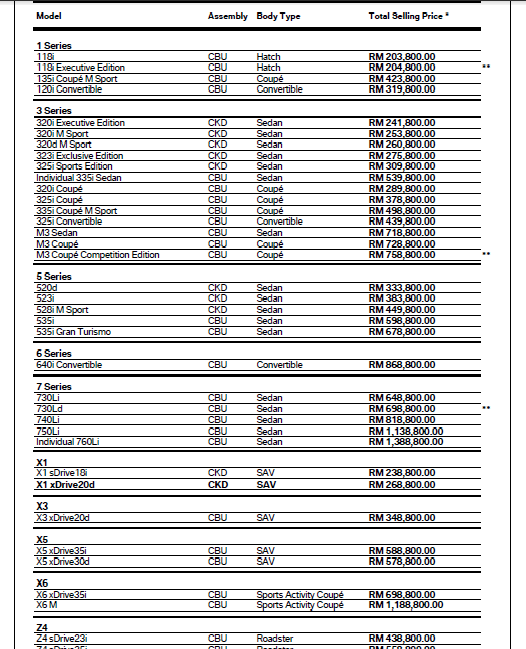
BMW Malaysia Price List

Effective August 1, 2011


Just some basic requirement of driving a BMW 3 series.
驾一辆宝马“3”系列到底需要什么基本的条件。
第一条件:钱
每月
车期供款:最少RM 3300
汽车电油:最少RM 400
每年
汽车保养与维修:最少RM1500
汽车保险与路税:最少RM4500
**RM6000 / 12MONTH =RM500

第二条件:还是钱
RM3300+RM400+RM500=。。。。
对,坐一辆宝马每月大概的费用最少是RM 4200

第三条件:要不然就是你老爸有的就是钱。

This is the data in 2008. Please take into account of inflation too.
Quoted from www.anthonytan.net @ 2008.